
How Travelgate Uses AI to Build Connectors Faster
 Posted by
Travelgate
Posted by
Travelgate
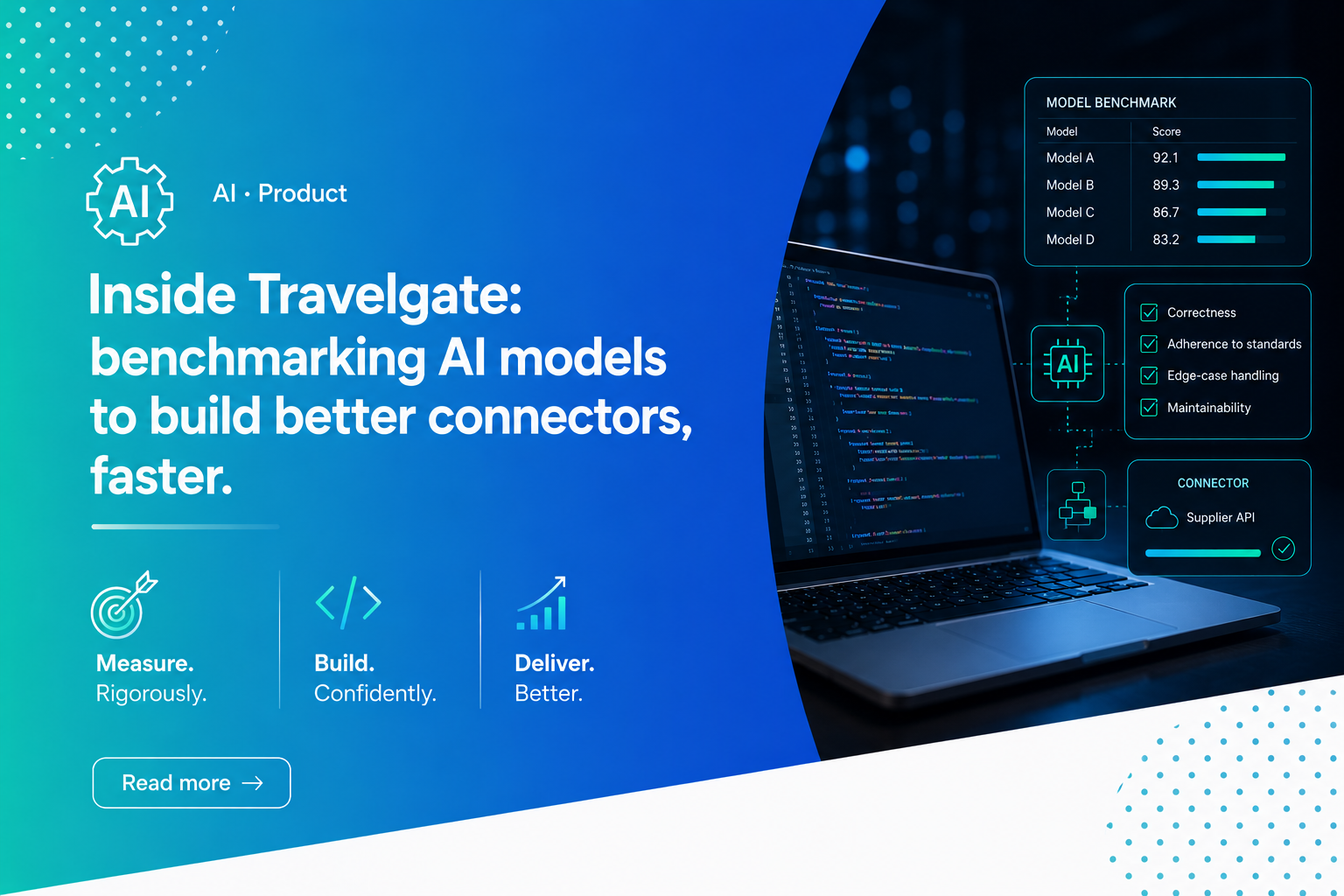
A behind-the-scenes look at how we test artificial intelligence before we trust it with our work.
Why we're telling you this
AI is everywhere right now, and a new "best" model seems to launch every few weeks. The real question for us was never "does it look impressive in a demo?" — it was:
Which AI actually builds a good, reliable Travelgate connector — and at what cost?
Rather than guess or follow the hype, we decided to find out with real evidence. This article explains, in plain terms, what we did, why we did it, and what it means for the people who work with us.
The problem we wanted to solve
Building a connector — the piece of software that lets Travelgate talk to a supplier's booking system — is detailed, technical work. AI can help speed that up. But not all AI models are equal, and picking the wrong one can mean:
- Lower-quality code that needs manual fixing later
- Paying more money for worse results
- Inconsistent work depending on which tool a developer happened to use
We wanted a way to make that decision based on facts, not opinions.
What we built: a fair, repeatable test
We created an internal testing process — think of it as a "driving test" for AI models. Every model is given:
- The exact same starting point — a clean project template and the same supplier instructions a new developer would receive.
- The exact same task — build the core booking features a connector needs (searching availability, getting a quote, booking, cancelling, and checking existing bookings).
- The exact same scoring — every result is graded against the same checklist, so every model is judged by the same standard.
Because every model faces identical conditions, we get a fair, apples-to-apples comparison instead of a guess.
We then looked at two things side by side for each model:
- How good is the result? (accuracy, quality, and how well it follows our standards)
- How much does it cost to get that result?
What we found
The results were genuinely useful. Some AI models produced excellent work but at a very high cost. Others delivered strong, reliable results at a fraction of the price. In other words: the most expensive option is not automatically the best value.
Armed with this data, we made two decisions:
- We simplified our toolkit, keeping only the AI models that consistently perform well.
- We chose one standard model for building new connectors — selected specifically because it offers the best balance of quality, reliability, and cost.
What this means for our Sellers and Buyers
To be clear: this is an internal improvement. It doesn't change how our platform behaves, how integrations work, or anything you interact with directly.
But the benefits reach you indirectly, in ways that matter:
- 🚀 Faster delivery — new suppliers and routes can be connected and made available more quickly.
- ✅ Higher, more consistent quality — because every connector is now built to a standard we've actually tested and validated, not just assumed to be "good enough."
- 💰 Smarter use of resources — money and time saved on tooling can be reinvested into improving the platform itself.
In short: the same team, doing more, doing it better, and doing it faster.
Why this matters going forward
New AI models will keep launching. Instead of chasing every headline or reacting to hype, we now have a repeatable, evidence-based process to evaluate any new model quickly and decide — with confidence — whether it's worth adopting.
That means Travelgate can keep improving how we work, while making sure quality and reliability never take a back seat.